
The week was dominated by two holds and a resignation: the Fed kept its rates unchanged on 28 October, the ECB did the same on 29 October, and Christine Lagarde announced she will leave Frankfurt on 7 February 2027. Yet the most useful document for anyone financing property came out more quietly, on 27 October: the ECB's survey of 159 banks shows a net 27% drop in demand for housing loans, the worst deterioration in access to retail funding since 2011, and a tightening announced for the fourth quarter. Groupe VINSIX explains how to read this survey, and what it changes for borrowers.
Two pauses that are not quite pauses
The Fed left its target range at 3.75% to 4% on 28 October. Chairman Kevin Warsh declined to give any guidance on December, recalled that inflation has run above target for close to six years, and revised first-half growth up from 1.8% to 2.4%, with unemployment at 4.2%. The next day the ECB's Governing Council unanimously held its deposit rate at 2.50%, after two increases in June and September. The statement notes that "financing conditions have tightened" since the previous meeting; Christine Lagarde sees no second-round effects, but leaves the door open to a December hike, which markets price at around 80%. A few hours earlier she had announced her resignation for 7 February 2027, nine months before the end of her term; the European Council will appoint her successor by qualified majority.
The two pauses tell the same story: the central banks did not need to raise rates because long-term yields and commercial banks did it for them. That is what the survey published on 27 October measures.
The week in figures
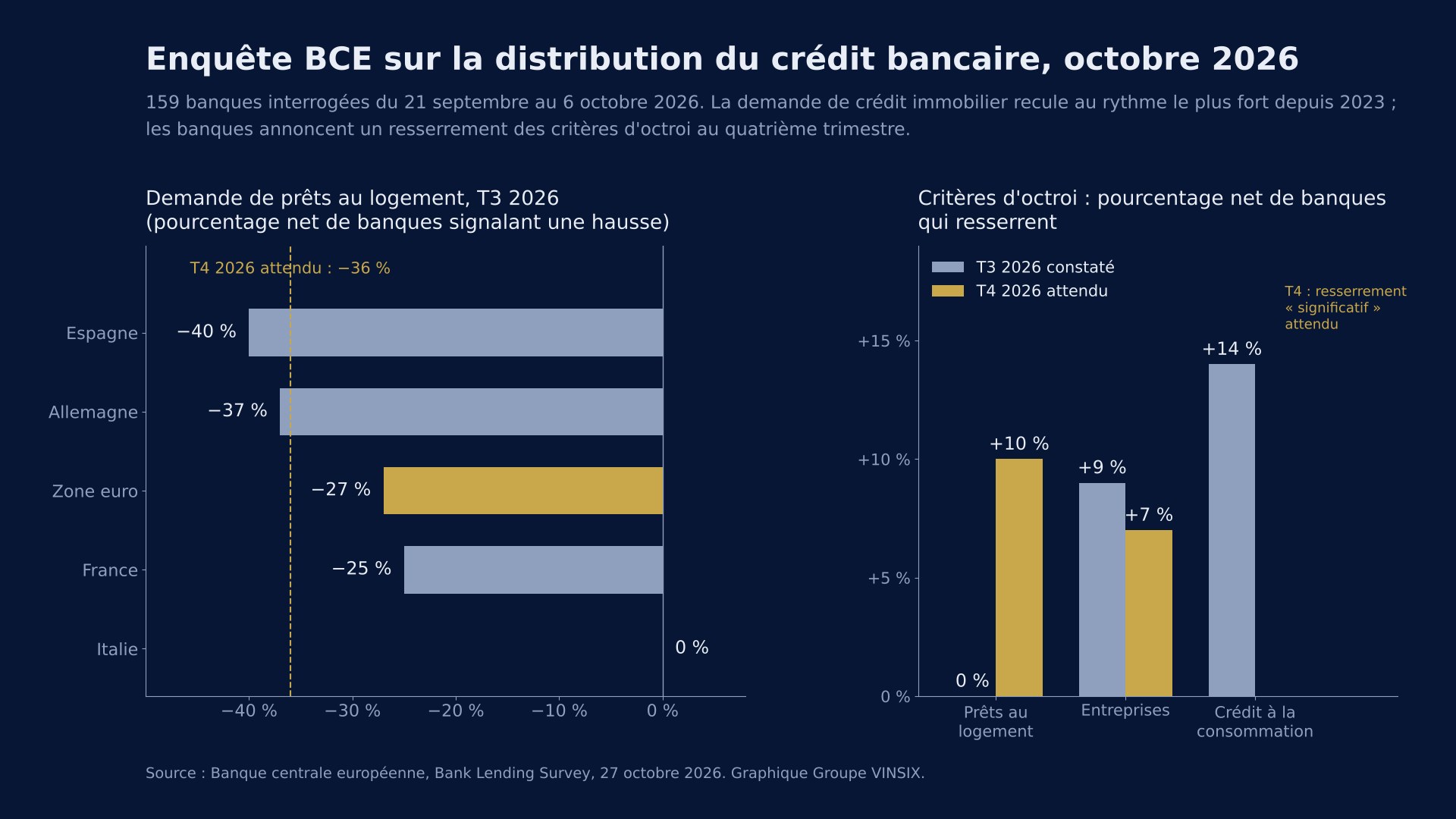
- ECB survey: demand for housing loans down a net 27% in the third quarter, against -15% in the second and -12% expected; the steepest fall since the third quarter of 2023; -36% expected in the fourth quarter
- Credit standards on housing loans: unchanged in the third quarter (0%), but a net 10% of banks plan to tighten in the fourth; share of rejected applications up a net 5%
- Firms: net tightening of 9% (7% in the second quarter, 5% expected, historical average 8%); in France a net 27% of banks tightened; consumer credit: tightening of 14%
- Banks' access to retail funding: net deterioration of 9%, the worst since the series began in 2011, above the 7% peak of the third quarter of 2023
- October inflation (national flash estimates): Italy 5.4%, Spain 4.9%, France 3.4% (3.8% harmonised), Germany 2.8% thanks to a temporary fuel tax cut; euro area flash on 4 November, after 3.8% in September
- France: average advertised twenty-year mortgage rate 3.66% in October according to Pretto, against 3.26% in the third quarter; ten-year OAT at 4.93% on 30 October, spread to the Bund 159 basis points against 172 on 23 October
How to read a net percentage
The ECB survey does not measure volumes but opinions. Every quarter, 159 euro area banks, this time surveyed from 21 September to 6 October, say whether they tightened or eased their standards, and whether the demand they receive rose or fell. The "net percentage" is the difference between the share of banks answering "up" and the share answering "down". A reading of -27% on housing loan demand therefore means that banks seeing demand fall outnumber those seeing it rise by 27 points. It is not a 27% fall in lending; it is a banking consensus, and it is rarely this clear-cut: the last comparable reading dates from the summer of 2023, at the peak of the previous hiking cycle.
Two subtleties matter. Banks had expected -12%: reality was more than twice as bad, the sign of a sharp turn rather than a slow erosion. And credit standards did not move in the third quarter: demand collapsed before the tightening, not because of it, with banks citing the level of interest rates first, then consumer confidence.
The average hides large gaps. In Spain demand comes out at -40%: lending there is largely floating-rate, and twelve-month Euribor, averaging 3.235% in October against 2.187% a year earlier, has already raised existing monthly payments. In Germany, -37%, even though banks slightly eased their standards. France stands at -25%, with unchanged standards on housing but a marked tightening on firms, a net 27%, the highest of the four large countries. Italy is the exception, at 0% on both counts.
The most worrying signal is not demand
The figure that financing professionals will remember lies on the banks' liability side. A net 9% of institutions report deteriorating access to retail funding, meaning their customers' deposits: the worst reading since the series began in 2011, above the 7% peak of the autumn of 2023. Access to bond and money markets has also deteriorated, and the shrinking of the ECB's balance sheet continues to weigh.
Why does this matter for property? Because a home loan is funded first on deposits, far cheaper than the market. When those deposits migrate to better-paid savings, the bank must raise market funding at a cost indexed to swaps and to its sovereign's signature. The survey confirms that margins on housing loans narrowed in the third quarter, as rate sheets lagged rising reference rates; restoring those margins is the real engine of the tightening announced for the fourth quarter, when a net 10% of banks plan to tighten housing standards.
A worked example: the same file, one quarter later
Take a household borrowing EUR 250,000 over twenty years, excluding insurance. At the third-quarter average rate according to Pretto, 3.26%, the monthly payment is EUR 1,419 and total interest EUR 90,622. At the October advertised rate, 3.66%, the payment rises to EUR 1,471 and interest to EUR 102,929. At 4%, the level several brokers expect by year-end, EUR 1,515 and EUR 113,588 of interest. Under the French rule capping the debt-service ratio at 35%, the net monthly income required for the same file moves from EUR 4,055 to EUR 4,202, then to EUR 4,328: EUR 273 of additional income demanded within a single quarter, for an unchanged project. That is, concretely, how demand falls before any bank has changed its criteria: part of the applicants no longer qualify, and the rest postpone.
French data confirm the mechanism: the Crédit Logement/CSA observatory measures lending down 9.2% year on year in the third quarter, an average term of 252 months and nearly one loan in two granted over twenty-five years. Households are stretching maturities to compensate.
What October inflation changes for December
October's national estimates were scattered: 5.4% in Italy, driven by energy up 31% year on year, 4.9% in Spain, 3.4% in France, but 2.8% in Germany thanks to a temporary fuel tax cut. Eurostat publishes the euro area figure on 4 November, expected between 3.7% and 4%, with Brent close to USD 110. For the ECB, the December choice comes down to this: energy inflation it does not control, against credit conditions tightening on their own, which chief economist Philip Lane noted as a factor that could limit how much tightening is needed. Bond markets breathed a little: the ten-year OAT came back from 5.05% to 4.93% in a week, and the spread to the Bund from 172 to 159 basis points.
The VINSIX reading
VINSIX observed over the past quarter, in the files submitted to it, the same lag the survey describes: lenders have not formally changed their analysis grids, but the coverage ratios they require have risen on their own, through the exit rate assumed in committee. In the consultations the Group runs with banks, the cost of funding is now raised from the first exchange, and institutions whose deposits are eroding are the first to cut their tickets or ask for a syndication.
Three lessons. On timing: tightening announced for the fourth quarter describes decisions already taken in the credit committees VINSIX deals with; a file presented in January will be assessed under those rules, not September's. On method: when standards are stable but rejections rise, it is the quality of the file, not the market, that makes the difference; the competitive lender process Groupe VINSIX organises aims to find the institution whose balance sheet still allows it to lend at yesterday's terms. On structure: when bank funding becomes scarce, debt arrangement and bond issuance become alternatives again, and the transactions the Group structures in 2026 combine a bank tranche and a bond tranche more often than before.
The ECB did not touch its rates this week; its banks, however, have already started closing the tap.
This article presents a general analysis and constitutes neither personalised advice nor any promise of return.
The Editorial Team — Groupe VINSIX
Sources
- Banque centrale européenne — October 2026 euro area bank lending survey, communiqué du 27 octobre 2026
- Banque centrale européenne — The euro area bank lending survey, third quarter of 2026 (rapport complet, détail par pays)
- Econostream — ECB bank lending survey: eurozone banks see further credit tightening as loan demand weakens (27 octobre 2026)
- Boursorama / Reuters — La BCE laisse ses taux inchangés, l'inflation pourrait peser sur la croissance (29 octobre 2026)
- Boursorama / AFP — La BCE laisse ses taux inchangés, Christine Lagarde démissionnera en février (29 octobre 2026)
- Euronews — Christine Lagarde quittera la présidence de la BCE en février, avant la fin de son mandat (29 octobre 2026)
- Federal Reserve — Transcript of Chairman Warsh's press conference, 28 October 2026
- Raisin — Live breakdown of the Fed policy statement, October 2026 (3.75-4.00 % held, unemployment 4.2 %)
- The Private Banker — Euro-zone inflation splits as Italy jumps to 5.4 % and Germany eases to 2.8 % (31 octobre 2026)
- Ideal-Investisseur — Écart OAT / Bund à dix ans, clôtures quotidiennes au 30 octobre 2026
- Rankia — Euríbor hoy 30 de octubre de 2026 (moyennes mensuelles et simulation de révision)
- LeCreditImmo / Pretto — Taux de crédit immobilier en octobre 2026 : 3,66 % sur 20 ans, pourquoi la Banque de France affiche encore 3,32 %
- Empruntis / Observatoire Crédit Logement-CSA — Taux immobiliers : une hausse qui s'accélère ? (troisième trimestre 2026)