
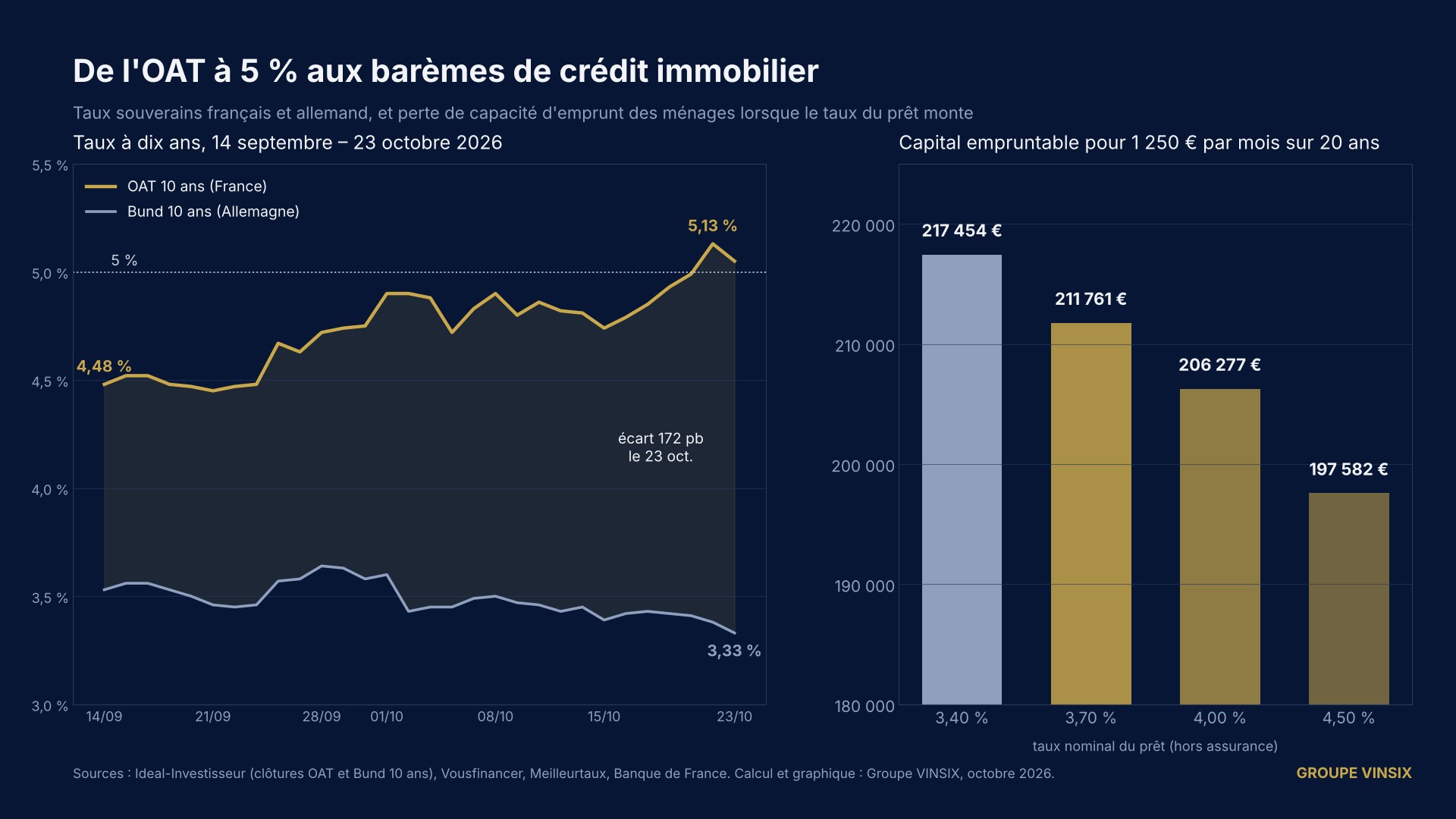
On Friday 23 October Moody's affirmed France's Aa3 rating, against what markets had priced in. The reprieve is real, but it comes after the move: in two weeks the ten-year OAT went from 4.74% to 5.13%, and mortgage rate sheets have started to follow. Groupe VINSIX describes the transmission mechanism, quantifies the loss of borrowing capacity, and looks at what the ECB and the Fed can change this week.
A reprieve, not a clean bill of health
Moody's ruled on the evening of 23 October: France keeps its Aa3 rating, with the negative outlook it has carried for a year. Most economists had expected a cut to A1, which would have aligned the agency with S&P and Fitch, both at A+. The statement is conditional: the rating "assumes that a deficit-reducing budget for 2027 will be adopted", and the agency expects "financing costs and social tensions will abate somewhat in the next few months". In other words, Moody's is not judging the situation; it is extending credit to a trajectory: a deficit brought from 5.4% to 5% of GDP, and a parliament able to pass a bill. S&P reports on 27 November, and the April 2027 presidential election makes a durable clarification unlikely within six months.
The week in figures
- Ten-year OAT: 5.13% at the close on 22 October, 5.14% intraday, the highest since July 2002; 5.05% on 23 October after Moody's
- Ten-year Bund: 3.33% on 23 October, down from 3.60% on 1 October; the France-Germany spread reached 171.8 basis points, against 95 in mid-September and a one-year average of 78.9
- Average advertised twenty-year mortgage rates: 3.70% on 21 October according to Vousfinancer; 3.50% to 3.55% after negotiation in October according to Meilleurtaux, against 3.40% in September; standard rate sheets at 3.86% over twenty-three years
- Banque de France: average rate on new home loans excluding renegotiations at 3.32% in August, up 24 basis points since January; production of EUR 12.2 billion
- Twelve-month Euribor: 3.267% on 23 October, against 2.156% a year earlier; three-month Euribor at 2.666%
- ECB: deposit rate at 2.50% since 10 September; decision on 29 October, with a hold priced at close to 90%; Fed: 3.75% to 4% range, decision on 28 October, a hold priced at 80%, a hike expected in December
- Fourth-quarter usury ceiling in France: 5.40% on loans of twenty years and more
Why a mortgage is not funded off the OAT
The attentive reader will notice a paradox: the French state borrows at 5.05% over ten years, while a household can still obtain 3.50% to 3.70% over twenty. We explained on 12 October why French households borrow more cheaply than their state: the bank does not fund itself on the OAT but on its deposits, remunerated well below that level, and on its own issuance, covered bonds first. Its market reference is not the sovereign but the swap curve, which reflects expectations for ECB rates. An amortising twenty-year loan has an average life of roughly eight or nine years; it is the swap at that horizon, plus the cost of liquidity and capital, plus the margin, that makes the rate sheet.
The OAT matters nonetheless, because the issuance cost of French banks is partly indexed to the signature of their state: when the France-Germany spread goes from 95 to 172 points in six weeks, the covered and senior bonds of French banks widen too, and that extra cost ends up in the grid. Vousfinancer measures the gap between the average twenty-year rate and the OAT at 1.30 points, a narrow level; it is that cushion which is being rebuilt, at the borrower's expense.
Transmission is slow, then abrupt
The lag between the market and the branch is measured in weeks. Banks revise their grids monthly; files in progress are processed at the rate sheet in force when they came in; and year-end targets hold back increases until lending envelopes are used up. The Banque de France figures, 3.30% in July and 3.32% in August, describe that inertia, and say nothing about October.
The second phase is faster. Meilleurtaux notes that the rise is "accelerating", that standard rate sheets moved from 3.69% in early September to 3.86%, and that the 4% mark is approaching. Vousfinancer expects an average twenty-year rate close to 4% by year-end and up to 4.50% by March 2027, with the best profiles still around 3.5%. A regulatory squeeze adds to this: the fourth-quarter usury ceiling, 5.40% APR on loans of twenty years and more, was computed over a period of stable rates; as rate sheets rise, insurance and fees push small loans and older borrowers above the cap. Meilleurtaux estimates that a twenty-year rate above 4% would exclude about 20% of its current clients unless they raise their down payment.
A worked example: what half a point costs
Take a household able to devote EUR 1,250 a month, excluding insurance, to a twenty-year loan. At 3.40%, September's average rate, it can borrow EUR 217,454. At 3.70%, the advertised rate on 21 October, EUR 211,761: EUR 5,700 less in one month. At 4%, the level expected by year-end, EUR 206,277. At 4.50%, the March 2027 scenario, EUR 197,582. Between the September rate sheet and next spring's, this household loses close to EUR 20,000 of capacity, 9% of its project, with no change in its income. Total interest rises over the same span from EUR 82,546 to EUR 102,418.
South of the Pyrenees, transmission runs through Euribor rather than rate sheets. Twelve-month Euribor stood at 3.267% on 23 October, against 2.156% a year earlier; October's provisional average, 3.224%, sits slightly below September's 3.247% but more than a full point above October 2025. For a floating-rate loan of EUR 167,000 over twenty-five years at Euribor + 0.75%, Rankia computes a monthly payment of about EUR 880, against EUR 786 before the annual reset: EUR 94 more a month. There, the move is already in household accounts; in France, it lies ahead.
What the central-bank week can change
The ECB meets on 28 and 29 October, having raised its deposit rate to 2.50% in September in the face of 3.8% inflation driven by energy. Futures put the probability of a hold at close to 90%, and roughly three chances in four on at least one hike by 17 December. In the United States, the Fed is expected to hold its 3.75% to 4% range on 28 October, with markets looking for a hike on 9 December and short-term rates possibly approaching 5% in early 2027.
For European mortgage lending the message is twofold. The short rate, which drives Euribor and therefore Spanish floating-rate loans, will not fall for a long time. The long rate, which drives French fixed-rate loans, depends more on the sovereign risk premium than on Frankfurt: Moody's has bought time, but a 2027 budget stripped of its savings or toppled by a no-confidence vote would send the OAT back above 5% more surely than any ECB decision.
What we take from this
VINSIX has observed this past quarter, in the analysis of the files submitted to it, that lenders have moved the conversation: the question is no longer today's rate, but whether the financing plan holds if the exit rate sits a full point higher. In the consultations the Group has run with banks, offers are more dispersed than in the spring, a deposit-rich institution holding its rate sheet while another, dependent on the bond market, passes on the sovereign spread almost in full.
Three lessons, then. For the buyer, the gap between the OAT and the rate sheet is a reprieve, not a guarantee; the useful question is not "will rates fall?" but "does my file clear the usury ceiling at 4%?". For the investor and the operator, fixed-rate funding secured today is worth more than an option on an easing that neither Moody's nor the ECB is promising; the structures Groupe VINSIX arranges now systematically include a scenario of long-term rates durably above 5%. For the public authorities, finally, every week of budgetary drift shows up in household borrowing capacity: the EUR 20,000 our typical household loses between September and March is the very concrete price of a 170-point risk premium.
Moody's did not change France's rating; the market has already changed the price of credit.
This article is a general analysis and does not constitute personalised advice or any promise of return.
The Editorial Team — Groupe VINSIX
Sources
- Reuters via Euronext — France spared Moody's ratings downgrade as it struggles with unrest (23 octobre 2026)
- Agence France Trésor — Les notations de la France (Moody's Aa3, S&P A+, Fitch A+, DBRS AA, Scope A+)
- Ideal-Investisseur — Écart OAT / Bund à dix ans, clôtures quotidiennes au 23 octobre 2026
- MySweetimmo / Vousfinancer — Crédit immobilier : l'OAT à 5 % pousse les taux à la hausse (22 octobre 2026)
- Meilleurtaux — Baromètre des taux immobiliers, octobre 2026
- Banque de France — Panorama des prêts à l'habitat des ménages (juillet 2026)
- Selectra — Crédit immobilier : la Banque de France confirme la remontée des taux (21 octobre 2026, données d'août)
- Euribor-rates.info — Fixings Euribor du 23 octobre 2026
- Rankia — Euríbor hoy 23 de octubre de 2026 (moyennes mensuelles et simulation)
- NewTrading — Hausse des taux BCE : le 29 octobre ou en décembre ?
- Forbes — What to look for from the Fed's October meeting (19 octobre 2026)