
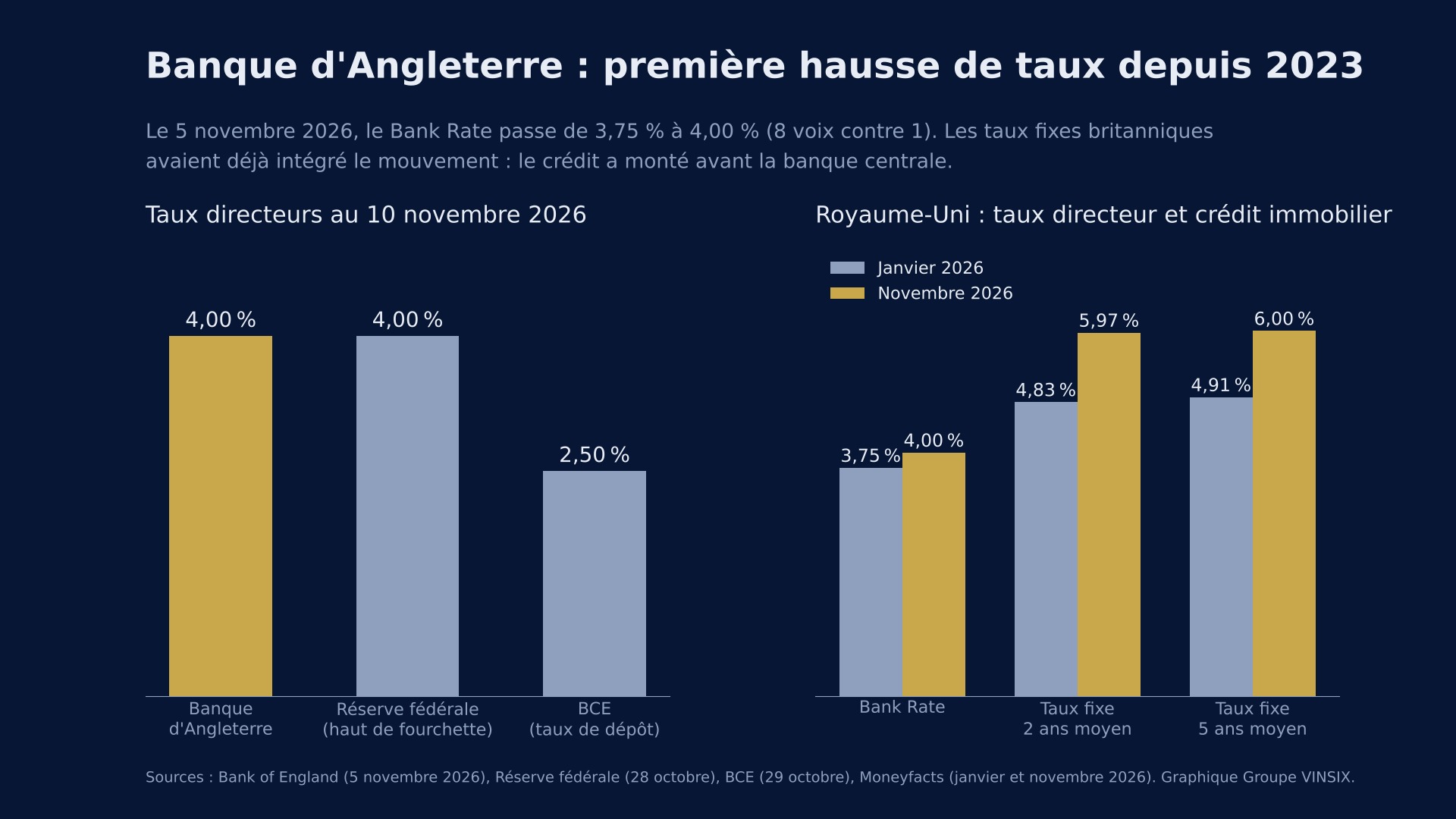
On 5 November, the Bank of England lifted Bank Rate from 3.75% to 4%, its first increase since August 2023. Few were surprised: UK lenders had priced it in weeks earlier, and fixed rates were already approaching 6%. That gap between the policy decision and the price of credit is the real story of the week, including for borrowers in euros.
An expected hike, a firmer vote than anticipated
The Monetary Policy Committee voted eight to one to raise Bank Rate by a quarter point to 4%. The single dissenter, Catherine Mann, wanted more: half a point, to 4.25%. Two members who had previously argued for holding, Swati Dhingra and Alan Taylor, joined the majority. The message is plain: in London the debate is no longer whether to tighten, but by how much.
Governor Andrew Bailey stressed that the move should not be read as the first in an inevitable long sequence of hikes. He nevertheless added that another increase looked likely unless the conflict in the Middle East is resolved. The next decision is due on 17 December.
Why now: energy, and the fear of second-round effects
UK inflation stood at 3.5% in September against a 2% target. The Bank expects it to rise towards 5% by mid-2027 as energy prices, disrupted by the Middle East conflict, feed through. It acknowledges that knock-on effects on wages and other prices remain limited so far, but judges that energy has stayed expensive long enough for them to emerge. Stronger-than-expected activity adds to that risk. Hence a hike framed as insurance rather than the start of a cycle.
The delay also reflects corporate behaviour. Part of the energy shock has been absorbed through lower profit margins, while fixed-price contracts and hedging have slowed the pass-through. Those buffers wear thin over time, and that is precisely the moment the Bank of England chose to act: before higher costs spread into selling prices and wages. For a central bank that was cutting rates as recently as December 2025, it is a notable change of course, and one that markets had largely anticipated.
Key figures
- Bank Rate: 4% since 5 November 2026, up from 3.75%; vote 8 to 1
- UK inflation: 3.5% in September, around 5% expected by mid-2027
- Average two-year fixed mortgage rate: 5.97% in early November, against 4.83% in January (Moneyfacts)
- Average five-year fixed rate: 6% in early November, against 4.91% in January
- 10-year gilt: 5.5% on 1 October, the highest since 2007, then around 5.15% after the decision
- Federal Reserve: 3.75% to 4% since September, unchanged on 28 October; ECB: deposit rate at 2.50%, unchanged on 29 October
UK credit had already done the journey
The paradox is only apparent. Between January and November, Bank Rate rose by a quarter point while the average two-year fix climbed by more than a full point. Lenders do not price fixed-rate loans off today's policy rate but off swap rates, the market's view of rates over the years ahead. The five-year swap stood at around 4.62% before the meeting: the hike was already in the price. The bond market confirmed it in its own way. The 10-year gilt touched 5.5% on 1 October, its highest since 2007, and the 30-year reached 6% for the first time since 1998. On decision day, by contrast, the 10-year slipped to just below 5.15%, a sign that a well-flagged hike delivered with cautious guidance reassures more than it alarms.
A worked example
Take a GBP 500,000 repayment mortgage over 25 years. At January's average fixed rate of 4.83%, the monthly payment is GBP 2,873.64. At November's average of 5.97%, it rises to GBP 3,212.34: GBP 338.70 more each month and GBP 4,064.43 a year. Over a two-year fixed term the difference exceeds GBP 8,100, for a borrower who saw the policy rate move by only a quarter point.
For an interest-only commercial facility indexed to SONIA, the sterling overnight rate that tracks Bank Rate, the pass-through is immediate: on GBP 10,000,000 outstanding, each quarter point costs GBP 25,000 of interest a year. Unhedged, the floating-rate borrower pays the hike on the day; with a fixed rate or a swap put in place too late, it has already paid it.
Three central banks, three stances
The Bank of England is moving while its two large peers pause. The Federal Reserve, which raised rates in September for the first time since 2023, held on 28 October, with two dissents in favour of a further hike. The ECB kept its deposit rate at 2.50% on 29 October, with euro-area inflation at 3.8%. Yet a central-bank pause does not shield European borrowers: in France the 10-year OAT crossed 5% on 21 October, and banks' mortgage pricing keeps rising. It is exactly the mechanism seen in London: the market does the work before the central bank.
My reading, for Groupe VINSIX
The first lesson is about timing. In the lender consultations Groupe VINSIX runs, in London and on the Continent, the cost of a financing is set when the offer is issued, not when the central bank meets. This year, on a complex structuring between the United Kingdom and continental Europe, I saw that a few weeks' head start in putting lenders in competition was worth more than any bet on the next policy decision.
The second is that hedging is not a luxury. An indexed facility with no cap or swap shifts the whole rate risk to the borrower, and that risk now shows up every month. The credit committees we approach look at cash-flow sensitivity to higher rates before they even look at asset value: a file that demonstrates its resilience to a rising-rate scenario earns better terms than one that ignores it.
The third is that the gap between London and Frankfurt may not last. If energy stays expensive, the ECB could resume its own hikes. This is a time for structuring rather than waiting: extending maturities where possible, diversifying funding sources, and considering a dedicated bond issue when the size justifies it. That is the core of our structured finance advisory work.
This article is a general analysis and constitutes neither personalised advice nor a promise of return.
Cyril Abensour — Managing Partner, Groupe VINSIX
Sources
- Bank of England — Bank Rate raised to 4%, November 2026 Monetary Policy Summary (5 novembre 2026)
- House of Commons Library — Interest rates and monetary policy: economic indicators (novembre 2026)
- Mortgage Trade Association — Monetary Policy Committee interest rate decision, November 2026 (6 novembre 2026)
- Moneyfacts — Mortgage rates and market news (novembre 2026)
- Fox Davidson — UK mortgage rates today, Moneyfacts November 2026 averages and swap rates (5 novembre 2026)
- Trading Economics — UK gilt yields surge as bond selloff intensifies (1er octobre 2026)
- Trading Economics — UK bond yields after the Bank of England decision (6 novembre 2026)
- Euronews — La BCE maintient les taux à 2,5 % (29 octobre 2026)
- GKToday — US Federal Reserve holds interest rates steady (28 octobre 2026)