
On 9 October 2026 the French state was borrowing for ten years at 4.86%. On the same day a household could obtain a twenty-year mortgage at around 3.60%. A private individual is therefore funding 1.25 points below the Treasury: a rare situation, held in place only by shock absorbers that are wearing thin. Above it sits a legal ceiling, the usury rate, just set at 5.40% for the fourth quarter. Groupe VINSIX takes the mechanism apart, with the arithmetic.
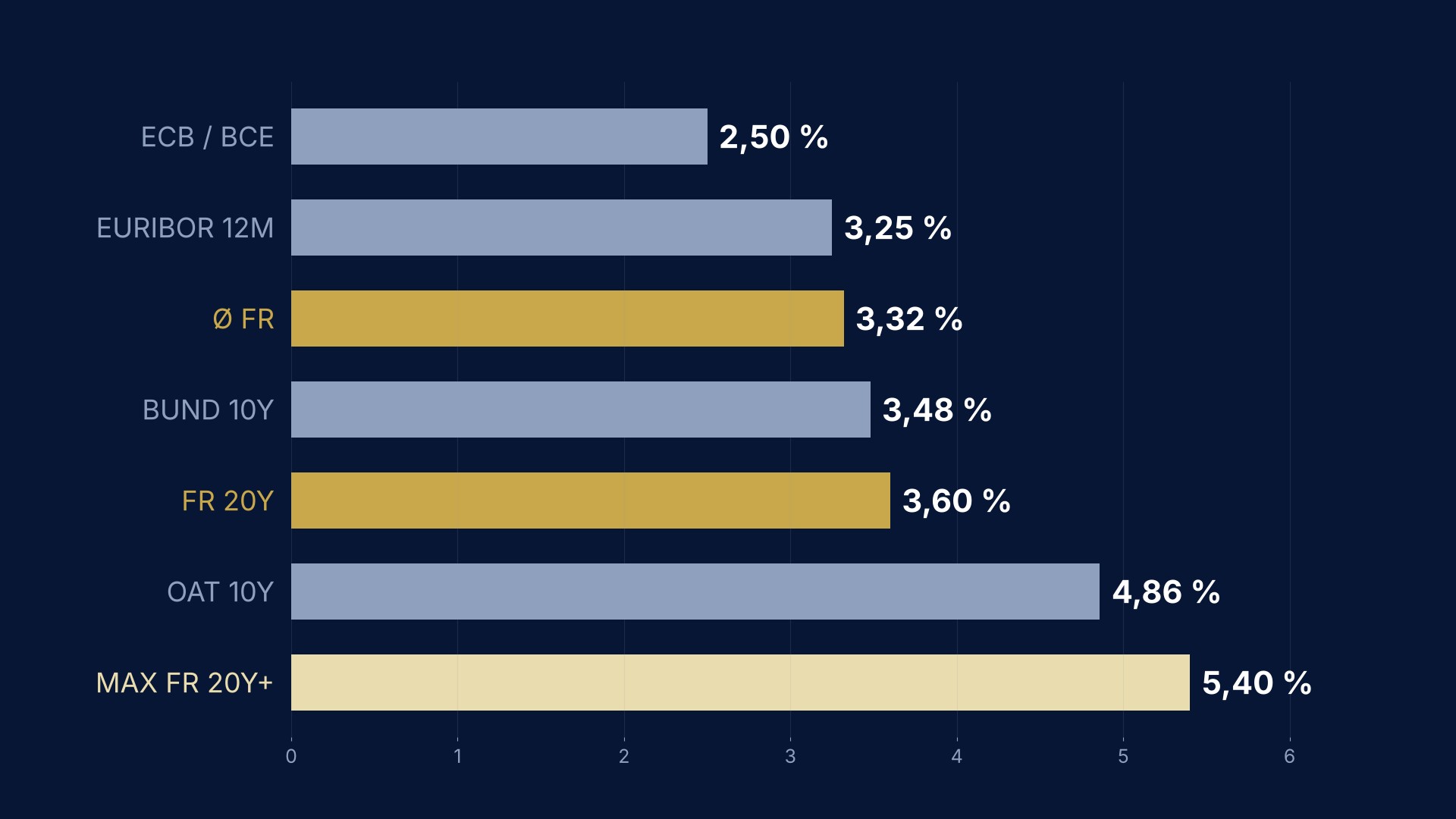
In an ordinary financial system the hierarchy of rates is simple: the state borrows at the lowest price, banks a little higher, companies and households higher still. France in October 2026 is an exception. The pressure on public debt has built so quickly that mortgage rate cards have not kept pace, leaving the individual better treated than the sovereign.
The rate ladder on 9 October 2026
- ECB: deposit rate at 2.50% since 16 September; next meeting on 29 October
- 12-month Euribor: about 3.25% on average in September, against 2.17% a year earlier
- Banque de France (published 6 October): average rate on new housing loans 3.32% in August, against 3.10% a year earlier; €12.2bn of new lending in the month
- Brokers' October rate cards: 3.60% to 3.66% over twenty years, 3.75% to 3.80% over twenty-five, up 0.07 to 0.15 point in a month
- 10-year government debt, close of 9 October: OAT 4.855%, Bund 3.477%, a spread of 138 basis points
- Fourth-quarter usury rate: 5.40% for fixed-rate loans of twenty years or more (5.29% the previous quarter), 4.68% for ten to under twenty years, 6.49% for bridging loans
- Euro area inflation, September flash estimate: 3.8%, after 3.2% in August; energy up 18.8% year on year
Why a bank lends below the sovereign yield
First explanation: a bank does not price its rate card off the OAT, but off the swap curve and its actual cost of funds. Much of the rise in the OAT reflects a premium specific to France: the Bund stands at 3.48%. Measured against that benchmark, a twenty-year loan at 3.60% leaves a margin of a dozen basis points, very thin but positive. Second: a large share of French bank balance sheets is funded by customer deposits, whose remuneration adjusts slowly. Third, a commercial reason: in France the mortgage remains a customer-acquisition product, granted at a low margin to capture a household's income, savings and insurance for twenty years.
All three absorbers are wearing out. Five-year credit default swaps on the subordinated debt of the large French banks have widened by 30 to 40 basis points since mid-September, to 131 basis points for BNP Paribas, 132 for Crédit Agricole and 142 for Société Générale, according to the Cercle de l'Épargne. A bank whose own signature becomes dearer ends up passing it on: in early October the new rate cards received by Vousfinancer showed increases of 0.10 to 0.30 point, and the least aggressive lenders already stood between 4% and 4.40%.
The usury rate: a ceiling that looks in the rear-view mirror
The usury rate is the maximum annual percentage rate (APR, or TAEG in French) at which a loan may be granted. It applies not to the nominal rate but to the full cost: interest, borrower insurance, security, arrangement and brokerage fees. The Banque de France computes it every quarter by a fixed rule: it takes the average effective rate charged over the previous quarter and adds one third. The 5.40% cap thus corresponds to an average effective rate of 4.05% observed in the third quarter on loans of twenty years or more.
The rule protects borrowers from abuse, but it has a design flaw: it follows the market one quarter late. The cap has just gained 0.11 point in three months, while some rate cards gained up to 0.30 point in one. For the cap to reach 5.80%, the average effective rate would first have to rise to 4.35%, which assumes such loans could be granted in the first place. During the 2022 to 2023 rate rise, this scissor effect shut out solvent borrowers, and the authorities had to move temporarily to a monthly revision.
A worked example: five basis points and the loan no longer passes
Take a €300,000 loan over twenty-five years at a nominal rate of 3.75%, with €4,500 of arrangement and security costs. The monthly payment before insurance is €1,542. For a borrower whose insurance costs 0.36% of the principal a year, or €90 a month, the APR comes to 4.53%: headroom under the cap is 0.87 point, and the nominal rate could rise to about 4.59% before hitting the usury limit.
Now change a single parameter. For an older borrower, or one with a health risk, insured at 0.90%, or €225 a month, the same loan at the same rate shows an APR of 5.36%: it passes, with 0.04 point to spare. Let the bank raise its rate card by five basis points, to 3.80%, and the APR reaches 5.41%: the loan becomes legally impossible, although the borrower's income has not moved by a euro. The cap does not sort by solvency; it sorts by the cost of insurance and the level of fees.
The Spanish counter-example
Spain offers a useful contrast. A large share of mortgages there is indexed to the 12-month Euribor, whose September average, close to 3.25%, is more than a point above that of September 2025. The rise is transmitted without delay: for a €150,000 loan over twenty-five years reset in October, the monthly payment increases by about €102, more than €1,200 a year. The Spanish system adjusts through price, and the existing borrower takes the shock. The French system, fixed-rate and capped, protects the existing borrower and adjusts through quantity: when the price can rise no further, it is access to credit that closes.
What could loosen the vice, or tighten it
Three variables will decide what comes next. The first is monetary: with inflation at 3.8% in the euro area, 3.4% in France and 5.0% in Spain, the ECB meeting of 29 October will take place under pressure, and markets still price two rate rises over twelve months. The second is fiscal: as long as the OAT-Bund spread stays near 140 basis points, long-term funding costs French banks more than their European competitors. The third is regulatory: a return to monthly revision of the usury rate would shorten the ceiling's lag without changing its principle.
What we take from it
Over the past quarter, in reviewing the files submitted to it, VINSIX has observed that the gap between lending to individuals and lending to professionals has widened. The credit committees the Group approaches for asset or project financings reason in terms of a margin over the day's swap rate: higher funding costs are passed on at once, and the validity of offers has shortened. The professional already pays the market price; the household still enjoys a rate-card price.
First lesson: a loan granted below the sovereign yield is not a lasting anomaly, it is a lag. Second lesson: under a capped regime the main risk is not paying more, but no longer being financeable; insurance and fees become structuring variables in their own right, alongside term and equity. Third lesson, for operators: when the bank window narrows, the value of putting a wide field of lenders in competition, French and foreign banks and debt funds, or of a dedicated bond issue, which is the core of Groupe VINSIX's structured financing advisory work, rises accordingly.
A ceiling calculated on last quarter says nothing about the next. In a market that moves thirty basis points in a month, a financing is better steered by watching the road than the mirror.
This article is a general analysis and constitutes neither personalised advice nor a promise of return.
The Editorial Team — Groupe VINSIX
Sources
- Banque de France — Crédits aux particuliers, août 2026 (publication du 6 octobre 2026)
- MoneyVox — Crédit immobilier : les nouveaux taux d'usure à partir du 1er octobre 2026 (28 septembre 2026)
- CreditNews — Taux d'usure du 4e trimestre 2026 : taux effectifs moyens et plafonds (29 septembre 2026)
- MySweetImmo — Crédit immobilier : les taux grimpent, barèmes Vousfinancer et Pretto d'octobre 2026 (3 octobre 2026)
- CAFPI — Les taux de crédit immobilier en octobre 2026
- Cercle de l'Épargne — Le Coin des épargnants du 9 octobre 2026 (OAT, Bund, CDS bancaires)
- Eurostat — Euro area annual inflation up to 3.8%, estimation rapide de septembre 2026 (2 octobre 2026)
- BCE — Décisions de politique monétaire du 10 septembre 2026
- Euribor.com.es — El euríbor cierra septiembre en el 3,243 % (30 septembre 2026)