
On 21 October France's ten-year yield crossed 5% for the first time since July 2002; it reached 5.14% the next day. Four days after a weekend of violence and looting, investors were not pricing the damage but what it revealed: a state struggling to hold both its accounts and public order. Groupe VINSIX looks at what France is already paying, and at what comes next.
What happened
On Saturday 17 October, protests against the cost of living drew between 500,000 and 800,000 people according to counts reported in the press, before degenerating into violence and looting in several cities. By Sunday the Interior Ministry had recorded 2,397 arrests and 997 police officers and gendarmes injured; the Commerce Minister counted at least 3,000 shops damaged or looted. Economist Marc Touati puts direct damage at around EUR 1.5 billion, against EUR 900 million for the yellow-vest protests and EUR 1 billion for the 2023 riots.
On Monday 19 October the CAC 40 fell 1.11%, the steepest drop among Europe's major markets; Société Générale, Crédit Agricole and BNP Paribas lost 2.5% to 3.4%, and the ten-year OAT rose from 4.80% to 4.93%. On Wednesday it crossed 5%; on Thursday it touched 5.14%.
Key figures
- Ten-year OAT: 5.14% on 22 October, the highest since 2002; 5% crossed on 21 October, when the 4% threshold had only been breached at the end of July
- Spread over the German Bund: about 170 basis points on 22 October, against 137 on 16 October; France pays nearly 40 points more than Italy
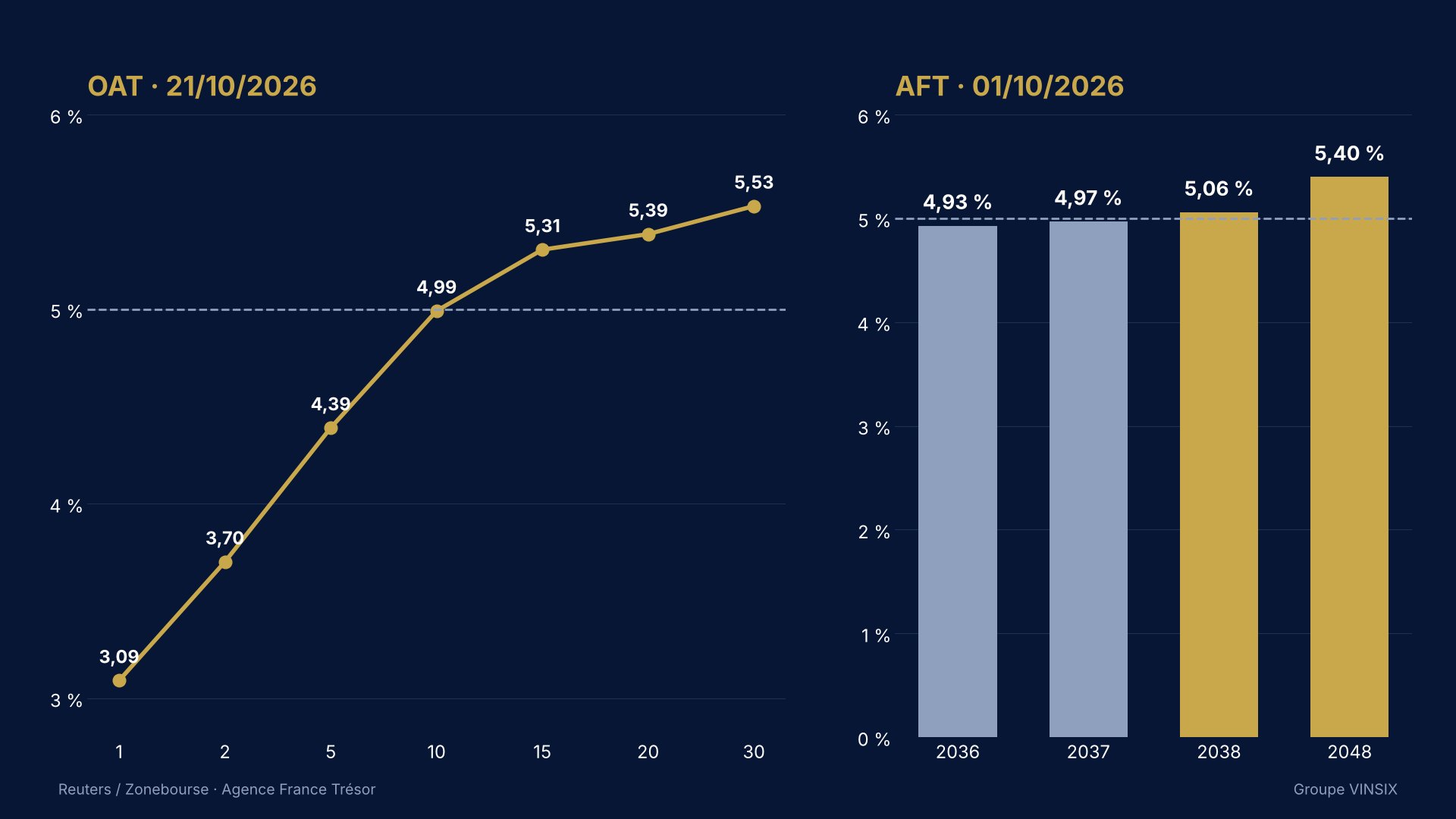
- Curve on 21 October: 2-year 3.70%, 5-year 4.39%, 15-year 5.31%, 30-year 5.53%
- Auction of 1 October: EUR 12 billion raised at 4.93% (2036), 4.97% (2037), 5.06% (2038) and 5.40% (2048)
- Public debt: EUR 3,595 billion at end-June, 119% of GDP; deficit expected at 5.4% of GDP in 2026, instead of the 5% promised
- Debt interest: EUR 62.6 billion in 2026, up to EUR 72.9 billion in 2027; EUR 340 billion of issuance planned for 2027, a record
- Ratings: Moody's Aa3, negative outlook, decision on 23 October; S&P and Fitch A+
Markets are not pricing shop windows, but a trajectory
One and a half billion euros of damage does not move a EUR 3,600 billion debt. What investors saw on 17 October was a country whose deficit is drifting to 5.4% of GDP, whose 2027 budget has not been passed, with 2,800 amendments pending and a vote on revenues postponed by a week, and whose authority is faltering in the streets. Moody's says it plainly: adoption of the budget and of the social security financing bill is "far from certain".
The lesson is an old one. A credible state is one that holds both its accounts and public order: investors lend for thirty years to institutions, and the state's ability to enforce the law is part of its signature. When the street sets parliament's agenda and the budgetary response comes down to more spending, the risk premium rises, and the taxpayer pays it.
Antoine Fraysse-Soulier (eToro) sums up investors' doubt: can France reconcile social calm with fiscal repair? Patrick Barbe (Neuberger Berman) notes that the spread is widening less because of a rush of sellers than because of a lack of buyers. Demand dries up for an issuer whose trajectory can no longer be read.
France is already borrowing above 5%
This is not a theoretical threshold. On 1 October the Agence France Trésor placed EUR 12 billion of OATs: the 2038 line went at 5.06%, the 2048 line at 5.40%. Since January the weighted average yield on issuance has reached 3.55%, against 3.14% in 2025. Every auction above that level writes the extra cost into the public accounts for ten, twenty or thirty years.
A worked example: the price of one morning's auction
On the EUR 12 billion raised on 1 October, the gap between the yields obtained, from 4.93% to 5.40%, and the year's average issuance yield of 3.55% amounts to about EUR 179 million of extra interest a year, and more than EUR 2.3 billion over the life of the bonds. Across the 2027 programme of EUR 340 billion, every additional point of yield will eventually cost EUR 3.4 billion a year.
The bill does not stop with the state. Christopher Dembik (Pictet AM) estimates that with the OAT at 5% and credit spreads of 150 to 180 points, the refinancing cost for some companies approaches 6.5% to 7%. Mortgage lending follows with a lag and only in part, but it follows: banks set their rates on their own funding cost, which tracks the sovereign's signature.
Where this is heading
Two scenarios dominate. The first is calm: a 2027 budget passed with credible savings, public order restored, a spread back towards its mid-October levels and a ten-year yield back below 5%. The second is persistence: a budget not passed or bought with more spending, a rating downgrade, a spread of 175 to 200 points in Allianz Research's adverse scenario, and a ten-year yield durably above 5%. Invesco expects spreads to stay high at least until mid-2027; the presidential election of April 2027 makes clarity unlikely before then.
On the evening of 23 October Moody's will decide. A one-notch cut, from Aa3 to A1, would align the agency with S&P and Fitch; Commerzbank sees a limited effect, as French debt is already priced, according to Pictet AM, like that of a BB+ issuer. The message matters more than the rating: without a credible plan to control spending, further downgrades will follow.
The VINSIX reading
Cyril Abensour, Managing Partner of Groupe VINSIX, has observed in a recent structuring that credit committees no longer settle for today's rate: they test French transactions against a scenario of long-term yields durably above 5%, and ask for a safety margin once reserved for peripheral issuers.
Three lessons. For borrowers, secure funding while lenders' rates have not yet absorbed the whole move, and widen the consultation beyond French lenders alone. For investors, the France risk premium creates entry points, provided the financing is long-term and does not bet on a quick return to yesterday's rates. For the public authorities, the answer markets expect fits in two phrases: spending under control, authority restored. Others argue first for new revenues and a social response; the markets have already given their reading.
France does not default at 5%; it pays the price of indecision. Every month lost is written into the cost of the debt for thirty years.
This article provides a general analysis and is neither personalised advice nor a promise of returns.
The Editorial Team — Groupe VINSIX
Sources
- Agence France Trésor — Adjudication du 1er octobre 2026 : 11,999 milliards d'euros d'OAT à long terme
- Reuters / Zonebourse — Le rendement de l'OAT à 10 ans atteint 5 % pour la première fois depuis juillet 2002 (21 octobre 2026)
- Boursorama — France : le rendement de l'OAT à dix ans grimpe à 5,14 % (22 octobre 2026)
- Saxo — Le taux à 10 ans franchit les 5 %, la confiance des marchés sous pression (22 octobre 2026)
- BFM Bourse — Pour la première fois depuis 2002, le taux d'emprunt à 10 ans de la France franchit le cap des 5 %
- Médiaterranée (AFP, Reuters) — Après les violences, l'OAT monte à 4,92 % et le CAC 40 cède 1,11 % avant Moody's (19 octobre 2026)
- Journal du Coin — Dette française : l'OAT frôle 5 %, les banques décrochent, Moody's tranche vendredi (20 octobre 2026)
- ABC Bourse — Après les violentes émeutes en France, les marchés dévissent (19 octobre 2026)