
$113,348 for every American, $75,208 for every French resident, $42,686 for every Swiss: divided by population, sovereign debt is dizzying. Yet the figure measures scale, not solvency. Markets made the point on 1 October 2026, when France borrowed for ten years at 4.92%, more than Italy, which owes more per head. Groupe VINSIX sets out what the ranking says, what it leaves out, and how it ends up in the cost of a property loan.
Dividing a state's debt by its population is a simple exercise, which explains its appeal: the result fits on one line and speaks to everyone. Reading it properly is another matter. One country can carry a high debt per person and borrow at 0.5%; another can owe less and pay more than 5%. What lies between the two is everything a lender cares about: growth, tax revenue, the currency, the central bank and investor confidence.
The ranking: two countries above $100,000 per person
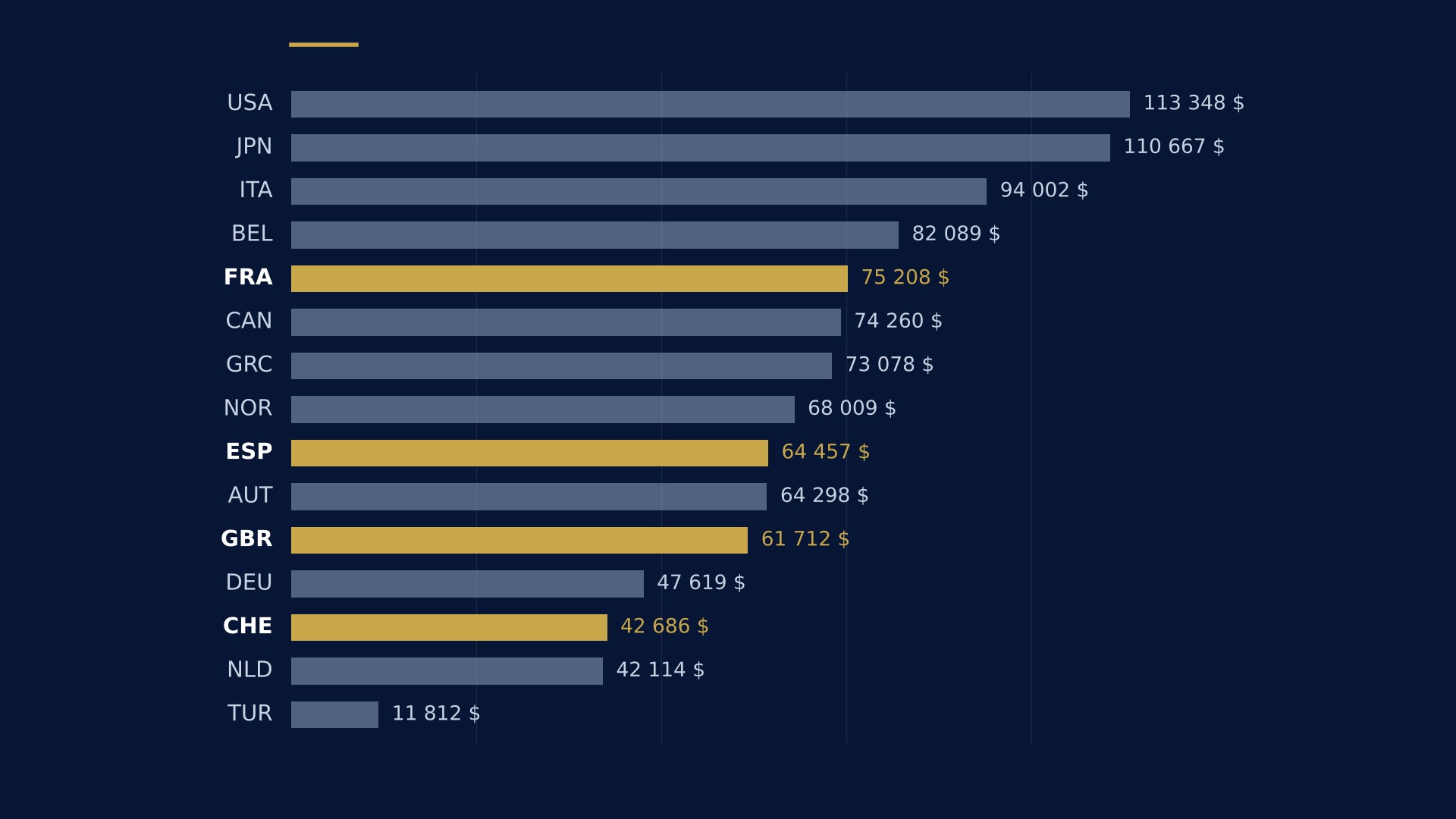
The data are the OECD's for 2025, expressed in purchasing-power-parity dollars, that is, adjusted for price differences between countries, and charted by Visual Capitalist on 23 September 2026. Of 39 countries, only two exceed $100,000 of gross government debt per person: the United States and Japan. Italy, Belgium and France follow. Germany, Switzerland and the Netherlands sit below $50,000, and Türkiye closes the list.
- United States: $113,348 per person; Japan: $110,667
- Italy: $94,002; Belgium: $82,089; France: $75,208; Canada: $74,260; Greece: $73,078
- Norway: $68,009; Spain: $64,457; Austria: $64,298; United Kingdom: $61,712
- Germany: $47,619; Switzerland: $42,686; Netherlands: $42,114; Türkiye: $11,812 (39th and last)
- OECD government bond debt outstanding: about $61 trillion in 2025, up from $55 trillion in 2024
- Euro area government debt: 88.9% of GDP in the first quarter of 2026, against 87.2% a year earlier (Eurostat)
- France, 1 October 2026: 10-year OAT at 4.92%, Bund at 3.62%, a gap of about 130 basis points
An American thus carries 2.4 times the debt of a German, and a French resident 58% more than the neighbour across the Rhine. The gap between the top and the bottom of the table is close to ten to one.
A mountain that grew by $6 trillion in a year
The ranking is a snapshot of a stock that keeps growing. According to the OECD's Global Debt Report 2026, government bonds outstanding in the OECD area reached about $61 trillion in 2025, $6 trillion more than a year earlier, and member countries' sovereign issuance is projected at $18 trillion in 2026, against $12 trillion in 2022. Governments and companies together borrowed a record $27 trillion from markets in 2025.
In the United States, gross federal debt crossed $40 trillion on 19 August 2026, less than five months after passing $39 trillion; it has doubled in ten years and interest costs exceed $1 trillion a year. In the euro area, Eurostat counts five countries above 100% of GDP in the first quarter of 2026: Greece (143.5%), Italy (138.9%), France (117.6%), Belgium (109.1%) and Spain (101.6%).
What the per-person figure does not tell you
First limit: it ignores the wealth produced. Greece owes less per person than France, $73,078 against $75,208, although its debt-to-GDP ratio is 26 points higher. Second limit: it ignores assets. Norway ranks eighth with $68,009 per person, yet the Norwegian state holds, through its sovereign wealth fund, financial assets far larger than its gross debt. Third limit: it ignores who holds the debt, at what maturity and in which currency. Japanese debt is largely held by residents and by the country's own central bank, which changes the nature of the risk.
Finally, the figure ignores direction. Over one year the Greek ratio fell by 9.4 points of GDP while the euro area's rose by 1.7 points. Investors buy a trajectory as much as a level.
The market's verdict: France now pays more than Italy
This was the event of the week. On 1 October 2026, the day the 2027 budget bill was presented, the French 10-year OAT yield touched 4.92%, a level not seen since 2002, after rising 61 basis points in September alone. The German Bund traded at 3.62%: the gap, about 130 basis points, is the widest since 2012. In early October Italy was borrowing for ten years at around 4.6 to 4.7%, Greece around 4.5%, Spain around 4.1% and Portugal around 4.0%. The United Kingdom and the United States were paying more than 5.3%, Japan about 3.1% and Switzerland about 0.5%.
Set against the ranking, the picture is instructive. Italy, third by debt per person, pays less than France, fifth. The United Kingdom, eleventh, pays more than both. Japan, second, borrows more cheaply than Germany, seventeenth. Markets do not price an amount per head: they price inflation, monetary policy, a fiscal path and the political capacity to hold it.
The French budget shows the mechanics. It provides for €43 billion of consolidation measures, a deficit cut from 5.4% of GDP in 2026 to 5.0% in 2027 and debt rising to 121.7% of GDP. Debt service would reach €72.9 billion in 2027, against €62.6 billion in 2026, a 16.5% increase and more than €1,000 per resident per year. The state plans to issue €340 billion of medium and long-term paper in 2027: on that vintage alone, each additional percentage point costs €3.4 billion of interest a year.
From the sovereign curve to the property loan
Why should a real estate borrower watch government bond yields? Because they reach the loan through three channels. The first is the reference rate: the sovereign curve and the swap curve, off which fixed-rate loans are priced, rise together when inflation and central banks push. The second is bank funding: a bank rarely funds itself more cheaply than its sovereign, and its covered bonds and senior debt carry the country premium. The third is asset values: when the 10-year government bond pays close to 5%, a building yielding less must offer rental growth, or see its value adjust.
The practical consequence: for the same quality, an asset in France now finances off a more expensive base than a comparable asset in Spain or Portugal, the reverse of the position only a few years ago.
A worked example: one point of rate and the covenant breaks
Take an office building producing €1.5 million of net operating income a year, financed by a €20 million interest-only loan with a minimum interest cover ratio (ICR) of 1.25x. At an all-in rate of 5.50%, interest is €1.10 million a year and the ICR is 1.36x: the covenant holds. If the all-in rate moves to 6.50%, interest rises to €1.30 million and the ICR falls to 1.15x: the covenant is breached. To return to 1.25x, debt must come down to about €18.46 million, meaning €1.54 million of additional equity. A single unhedged point is enough to turn a comfortable file into one that needs restructuring.
The VINSIX reading
Over the past quarter, in the lender consultations it has run, VINSIX has observed that the country premium has again become an explicit line in term sheets: debt funds and foreign banks now distinguish, for comparable assets, a French file from a Spanish one, and shorten the validity of their offers when sovereign yields move ten basis points in a day. Cyril Abensour, Managing Partner of Groupe VINSIX, noted in the course of a complex structuring that the longest discussion was no longer about the lender's margin, but about the interest rate hedge and the exact date on which it would be fixed.
Three lessons follow. First, debt per person makes a good headline and a poor decision tool; what is actually paid is the yield spread, and it can be read every morning. Second, in a market where the sovereign itself is volatile, structure matters more than the headline rate, whether that is the hedge, the amortisation profile or the headroom left on covenants. Third, putting lenders in competition, which is central to Groupe VINSIX's structured financing advisory work, is worth more when views of country risk differ from one institution to the next; for amounts that justify it, a dedicated bond issue also locks in a cost over the full term.
OECD governments have $18 trillion of paper to place this year. The real estate borrower stands at the same window, just behind them: better to arrive with a structured file than with a ranking.
This article is a general analysis and constitutes neither personalised advice nor a promise of return.
The Editorial Team — Groupe VINSIX
Sources
- Visual Capitalist — Ranked: Countries With the Most Government Debt Per Person (23 septembre 2026, données OCDE)
- OCDE — Global Debt Report 2026 (mars 2026)
- Eurostat — Government debt at 88.9% of GDP in euro area, premier trimestre 2026 (21 juillet 2026)
- Committee for a Responsible Federal Budget — Gross National Debt Reaches $40 Trillion (19 août 2026)
- ABC Bourse — Dette française : le taux à 10 ans atteint 4,92 %, un sommet inédit depuis 2002 (1er octobre 2026)
- Boursorama — Taux souverains à dix ans (relevé du 2 octobre 2026)
- Trading Economics — Government bond yields by country (début octobre 2026)
- Public Sénat — Budget 2027 : un effort de 43 milliards d'euros (1er octobre 2026)
- France Transactions — La France devra emprunter 339,7 milliards d'euros en 2027 (29 septembre 2026)