
On 16 October Eurostat confirmed euro area inflation at 3.8% for September, twice the target, two days after a US reading of 3.7%. In both cases energy accounts for most of the rise and underlying inflation stays close to 2.5%. This two-speed inflation leaves the ECB, which meets on 29 October, and the Fed, on 28 October, facing the same dilemma. For property borrowers the real issue lies elsewhere: in long-term yields that are not coming down. Groupe VINSIX takes stock, with a worked example.
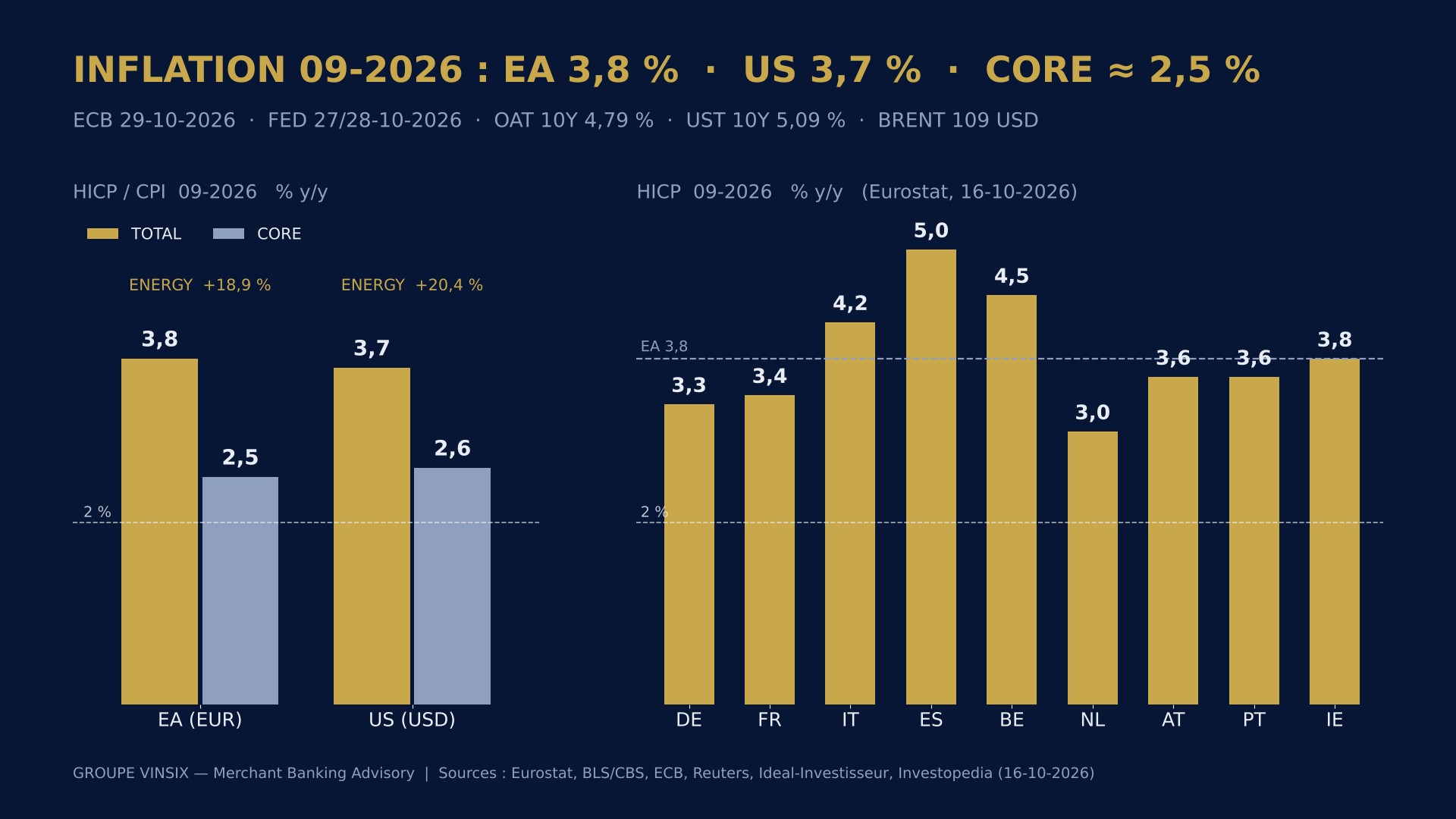
On 14 October the US consumer price index for September came in at 3.7% year on year, above the 3.6% expected. On 16 October Eurostat confirmed its flash estimate for the euro area: 3.8%, after 3.2% in August and 2.2% a year earlier. The same temperature on both sides of the Atlantic, and the same diagnosis: an energy shock layered on top of contained underlying inflation.
The week's figures
- Euro area, September 2026 (Eurostat, 16 October): 3.8% year on year; energy +18.9% (contribution 1.71 points), services +3.2%, food +1.3%; excluding energy and food: 2.5%
- By country: Germany 3.3%, France 3.4%, Italy 4.2%, Spain 5.0%, Belgium 4.5%; inflation rose in 23 of 27 member states
- United States, September 2026 (14 October): 3.7% year on year (3.4% in August), core 2.6%; energy +20.4%, gasoline +9.1% in the month alone
- Markets at 16 October: 10-year OAT 4.79%, Bund 3.42%, spread 137 basis points; 10-year US Treasury 5.09%, after a peak of 5.33% on 14 October; Brent at $109.55
- 12-month Euribor: provisional October average 3.216%, against 2.187% in October 2025
- ECB deposit rate 2.50% since 10 September, meeting on 29 October; Fed at 3.75–4.00%, meeting on 27-28 October; probability of a Fed hike priced on 16 October: 17% in October, 89% in December
An energy inflation, not a demand inflation
Eurostat's breakdown leaves little room for doubt. Of the euro area's 3.8 points of inflation, 1.71 points come from energy, 45% of the total for an item that weighs less than a tenth of the basket. Services, the heart of domestic inflation, are rising by 3.2%, exactly as in September 2025; food is slowing to 1.3%. Excluding energy and food, the index stands at 2.5%, half a point from target, and it has not moved since the summer.
The American profile is the same, only sharper: gasoline jumped 9.1% in a single month, accounting for more than half of the monthly rise in the index. Core inflation, at 2.6%, is edging up: transport costs are beginning to seep through. It is this seepage, not oil itself, that central banks are watching. The ECB, which raised rates on 10 September, was then projecting inflation of 3.0% in 2026: September sits above that path.
Two central banks, one dilemma
A central bank can do nothing about a barrel priced by a strait: raising rates against a supply shock brakes an economy already slowed by the energy bill, but letting inflation run near 4% risks wages and service prices adjusting to it. The choice in 2022 was to tighten hard and late; the choice in 2026 appears to be to tighten early and little.
The Reuters poll of 73 economists conducted on 5-8 October sums up expectations: 70 expect the deposit rate to stay at 2.50% on 29 October, 64 expect a quarter-point rise in December. A majority sees the deposit rate peaking at 2.75%, but 24 economists now mention 3.00%. In the United States, the September index briefly lifted the probability of a Fed hike as early as 28 October to 50%, before a correction in technology stocks brought it back to 17%; a December hike is still regarded as almost certain. The question is no longer whether policy rates rise, but whether one or two increases will be enough; the ECB's bank lending survey, due on 20 October, will show whether the second-quarter tightening has continued.
Real rates: the reading that matters for property
For a property investor the decisive variable is not the policy rate but the long rate, and more precisely the real rate, corrected for inflation. With the 10-year OAT at 4.79% and inflation at 3.8%, the French real rate is about 1%. Measured against core inflation, the part that will remain once the energy shock has faded, it reaches 2.3%. In the United States, 5.09% against 3.7% gives 1.4%, and 2.5% against core.
These levels are high by the standards of the past decade, and they are not falling: the US 10-year touched 5.33% on 14 October, a level not seen since 2007. Christine Lagarde said it in September: the rise in long-term yields is a global phenomenon, fed by the financing needs of artificial intelligence and by the size of US issuance. European property assets, whose value is measured against a risk-free rate, feel that competition for long-term capital even when the ECB stands still.
A worked example: rent indexation does not catch up with the cost of debt
Inflation is said to be the friend of the leveraged investor, because rents are indexed and debt is not. The argument holds for fixed-rate debt; it reverses for floating-rate debt, the rule in commercial property finance. Take an office building financed with a €10 million loan, amortising over fifteen years, indexed to 12-month Euribor plus 1.80%, with net annual rent of €1.2 million.
In October 2025, with Euribor at 2.187%, the all-in rate was 3.99% and the annual debt service €887,000: the debt service coverage ratio (DSCR) stood at 1.35. In October 2026, Euribor at 3.216% lifts the rate to 5.02% and the annual payment to €950,000, €63,000 more. With rent unchanged the DSCR falls to 1.26. If rent is indexed by 3.8%, in line with inflation, it moves to €1.246 million and the DSCR recovers to 1.31: indexation recovers half of the deterioration, no more. Returning to 1.35 would require rent up 6.9%, almost twice the inflation recorded.
The VINSIX reading
In the consultations launched with lenders by the Group in recent weeks, VINSIX has observed that the discussion no longer centres on the margin, which has stabilised, but on the reference rate and its hedging. The credit committees approached stress-test income with Euribor one point above the day's level, often require hedging, by swap or cap, from day one, and accept rent indexation as a cushion only in proportion to core inflation.
Three lessons. Energy inflation is not rent inflation: lease indices will follow, late and in part, while the cost of floating-rate debt follows at once. For a property financing, the ECB's decision of 29 October matters less than the path of global long-term yields, where European real estate competes for capital with sovereign issuance and the infrastructure of artificial intelligence. Finally, the structure of the debt becomes the first lever again: fixed and floating shares, hedging, competition between banks and debt funds, or a dedicated bond issue whose coupon is known from the first day, the core of Groupe VINSIX's structured financing advisory work.
An energy shock always passes in the end. What stays on a balance sheet is the rate at which it was crossed.
This article is a general analysis and constitutes neither personalised advice nor a promise of return.
The Editorial Team — Groupe VINSIX
Sources
- Eurostat — Annual inflation up to 3.8% in the euro area, septembre 2026 (16 octobre 2026)
- BCE — Déclaration de politique monétaire et conférence de presse du 10 septembre 2026
- BCE — Enquête sur la distribution du crédit bancaire, deuxième trimestre 2026 (21 juillet 2026)
- Reuters / FXStreet — ECB expected to pause in October before hiking rates in December, sondage du 5 au 8 octobre 2026
- CBS News — September CPI report shows inflation accelerated to 3.7% as energy costs soared (14 octobre 2026)
- Investopedia / Yahoo Finance — Markets News, Oct. 16, 2026 : rendement à dix ans, pétrole, probabilités FedWatch
- Ideal-Investisseur — Écart OAT / Bund au 16 octobre 2026 (137,4 points de base)
- Kelisto — Euríbor hoy, 16 de octubre de 2026 : valeur quotidienne et moyenne mensuelle
- FXStreet — Markets just priced out rate hikes on financial stress (5 octobre 2026) : écart France-Allemagne et anticipations BCE
- Trading Economics — Brent crude oil (19 octobre 2026)